
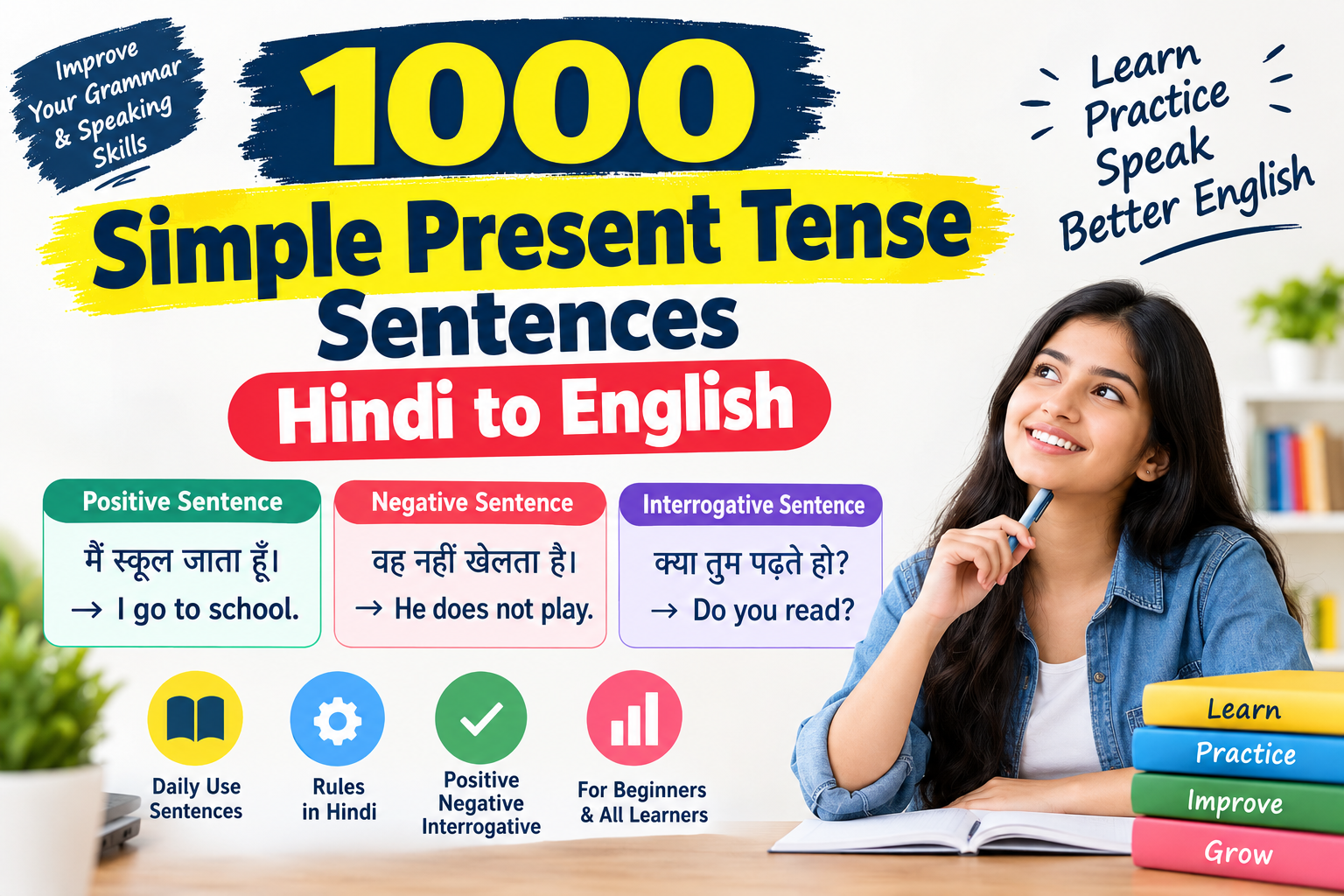
Simple Present Tense के 1000 Hindi to English Sentences
Simple Present Tense का नियम
| Sentence Type | Structure | Example |
|---|---|---|
| Positive | Subject + V1/V1+s/es | He plays cricket. |
| Negative | Subject + do/does not + V1 | He does not play cricket. |
| Question | Do/Does + subject + V1? | Does he play cricket? |
याद रखें:
- I, We, You, They के साथ verb की पहली form आती है।
- He, She, It और किसी एक व्यक्ति के नाम के साथ verb में s/es लगता है।
- Does के साथ verb में s/es नहीं लगता। Part 1: Daily Routine Sentences (1–100)
- मैं रोज़ सुबह जल्दी उठता हूँ। — I get up early every morning.
- मैं रोज़ ब्रश करता हूँ। — I brush my teeth every day.
- मैं रोज़ नहाता हूँ। — I take a bath every day.
- मैं सुबह चाय पीता हूँ। — I drink tea in the morning.
- मैं रोज़ अखबार पढ़ता हूँ। — I read the newspaper every day.
- मैं रोज़ व्यायाम करता हूँ। — I exercise every day.
- मैं सुबह टहलने जाता हूँ। — I go for a walk in the morning.
- मैं रोज़ स्कूल जाता हूँ। — I go to school every day.
- मैं रोज़ ऑफिस जाता हूँ। — I go to the office every day.
- मैं समय पर खाना खाता हूँ। — I eat on time.
- मैं रोज़ अंग्रेज़ी सीखता हूँ। — I learn English every day.
- मैं रोज़ किताबें पढ़ता हूँ। — I read books every day.
- मैं रात को जल्दी सोता हूँ। — I go to bed early at night.
- मैं अपना काम समय पर करता हूँ। — I do my work on time.
- मैं अपने माता-पिता की मदद करता हूँ। — I help my parents.
- मैं रोज़ भगवान की पूजा करता हूँ। — I pray to God every day.
- मैं सुबह पानी पीता हूँ। — I drink water in the morning.
- मैं रोज़ अपने दोस्तों से मिलता हूँ। — I meet my friends every day.
- मैं अपना कमरा साफ करता हूँ। — I clean my room.
- मैं रोज़ अपना होमवर्क करता हूँ। — I do my homework every day.
- वह सुबह जल्दी उठता है। — He gets up early in the morning.
- वह रोज़ दूध पीता है। — He drinks milk every day.
- वह स्कूल बस से जाता है। — He goes to school by bus.
- वह रोज़ क्रिकेट खेलता है। — He plays cricket every day.
- वह अच्छी अंग्रेज़ी बोलता है। — He speaks English well.
- वह अपना काम खुद करता है। — He does his work himself.
- वह रोज़ खाना बनाती है। — She cooks food every day.
- वह सुबह योग करती है। — She does yoga in the morning.
- वह रोज़ मंदिर जाती है। — She goes to the temple every day.
- वह सुंदर गाना गाती है। — She sings a beautiful song.
- मेरी माँ स्वादिष्ट खाना बनाती हैं। — My mother cooks delicious food.
- मेरे पिता ऑफिस जाते हैं। — My father goes to the office.
- मेरा भाई फुटबॉल खेलता है। — My brother plays football.
- मेरी बहन किताबें पढ़ती है। — My sister reads books.
- मेरा दोस्त मुझे फोन करता है। — My friend calls me.
- मेरा परिवार दिल्ली में रहता है। — My family lives in Delhi.
- हम साथ में खाना खाते हैं। — We eat together.
- हम रोज़ स्कूल जाते हैं। — We go to school every day.
- हम शाम को खेलते हैं। — We play in the evening.
- हम अंग्रेज़ी में बात करते हैं। — We speak in English.
- वे सुबह दौड़ते हैं। — They run in the morning.
- वे रोज़ मेहनत करते हैं। — They work hard every day.
- बच्चे पार्क में खेलते हैं। — Children play in the park.
- विद्यार्थी अपने शिक्षक का सम्मान करते हैं। — Students respect their teacher.
- शिक्षक हमें अंग्रेज़ी पढ़ाते हैं। — Teachers teach us English.
- किसान खेतों में काम करते हैं। — Farmers work in the fields.
- दुकानदार सामान बेचता है। — The shopkeeper sells goods.
- डॉक्टर मरीजों का इलाज करता है। — The doctor treats patients.
- पुलिस लोगों की मदद करती है। — The police help people.
- ड्राइवर बस चलाता है। — The driver drives the bus.
- मैं रोज़ अपने दाँत साफ करता हूँ। — I clean my teeth every day.
- मैं अपने कपड़े खुद धोता हूँ। — I wash my clothes myself.
- मैं हर रविवार बाजार जाता हूँ। — I go to the market every Sunday.
- मैं रोज़ अपना बैग तैयार करता हूँ। — I prepare my bag every day.
- मैं अपना समय बर्बाद नहीं करता हूँ। — I do not waste my time.
- मैं हमेशा सच बोलता हूँ। — I always tell the truth.
- मैं किसी से झूठ नहीं बोलता हूँ। — I do not lie to anyone.
- मैं रोज़ नई चीजें सीखता हूँ। — I learn new things every day.
- मैं अपना वादा निभाता हूँ। — I keep my promise.
- मैं दूसरों की मदद करता हूँ। — I help others.
- वह हमेशा समय पर आता है। — He always arrives on time.
- वह कभी देर नहीं करता है। — He never gets late.
- वह रोज़ अपना काम पूरा करता है। — He completes his work every day.
- वह अपने दोस्तों पर भरोसा करता है। — He trusts his friends.
- वह अपने परिवार से प्यार करता है। — He loves his family.
- वह हमेशा सच बोलती है। — She always tells the truth.
- वह किसी को परेशान नहीं करती है। — She does not trouble anyone.
- वह रोज़ पौधों को पानी देती है। — She waters the plants every day.
- वह अपने कपड़े खुद चुनती है। — She chooses her clothes herself.
- वह अपने पैसे बचाती है। — She saves her money.
- हम रोज़ समाचार देखते हैं। — We watch the news every day.
- हम अपने घर को साफ रखते हैं। — We keep our house clean.
- हम बड़ों का सम्मान करते हैं। — We respect our elders.
- हम गरीबों की मदद करते हैं। — We help poor people.
- हम रोज़ अंग्रेज़ी बोलने का अभ्यास करते हैं। — We practise speaking English every day.
- वे हर दिन नई बातें सीखते हैं। — They learn new things every day.
- वे अपना काम ध्यान से करते हैं। — They do their work carefully.
- वे हर रविवार मंदिर जाते हैं। — They go to the temple every Sunday.
- वे अपने माता-पिता की बात मानते हैं। — They obey their parents.
- वे हमेशा एक-दूसरे की मदद करते हैं। — They always help each other.
- सूरज पूर्व से निकलता है। — The sun rises in the east.
- सूरज पश्चिम में डूबता है। — The sun sets in the west.
- पृथ्वी सूर्य के चारों ओर घूमती है। — The Earth revolves around the Sun.
- पृथ्वी पर जीवन मौजूद है। — Life exists on Earth.
- पानी 100 डिग्री सेल्सियस पर उबलता है। — Water boils at 100 degrees Celsius at standard atmospheric pressure.
- बर्फ गर्मी में पिघलती है। — Ice melts in heat.
- मछलियाँ पानी में रहती हैं। — Fish live in water.
- पक्षी आसमान में उड़ते हैं। — Birds fly in the sky.
- गाय हमें दूध देती है। — A cow gives us milk.
- पेड़ हमें ऑक्सीजन देते हैं। — Trees give us oxygen.
- मुझे चाय पसंद है। — I like tea.
- मुझे क्रिकेट पसंद है। — I like cricket.
- मुझे अंग्रेज़ी सीखना पसंद है। — I like learning English.
- मुझे झूठ पसंद नहीं है। — I do not like lies.
- उसे मिठाई पसंद है। — He likes sweets.
- उसे फिल्में देखना पसंद है। — She likes watching movies.
- हमें भारतीय खाना पसंद है। — We like Indian food.
- उन्हें संगीत पसंद है। — They like music.
- मेरा दोस्त बहुत हँसता है। — My friend laughs a lot.
- मेरा भाई हमेशा मेरी मदद करता है। — My brother always helps me. Part 2: Family, Home and Relationships (101–200)
- मेरे दादाजी सुबह टहलते हैं। — My grandfather goes for a walk in the morning.
- मेरी दादी अच्छी कहानियाँ सुनाती हैं। — My grandmother tells good stories.
- मेरे चाचा एक दुकान चलाते हैं। — My uncle runs a shop.
- मेरी चाची स्वादिष्ट खाना बनाती हैं। — My aunt cooks delicious food.
- मेरा बेटा स्कूल जाता है। — My son goes to school.
- मेरी बेटी डांस सीखती है। — My daughter learns dancing.
- मेरा छोटा भाई वीडियो गेम खेलता है। — My younger brother plays video games.
- मेरी बड़ी बहन नौकरी करती है। — My elder sister works.
- मेरे माता-पिता मेरी चिंता करते हैं। — My parents worry about me.
- मेरा परिवार मेरा समर्थन करता है। — My family supports me.
- मेरी माँ मुझे रोज़ फोन करती हैं। — My mother calls me every day.
- मेरे पिता सुबह अखबार पढ़ते हैं। — My father reads the newspaper in the morning.
- मेरी बहन मेरे साथ रहती है। — My sister lives with me.
- मेरा भाई मेरी बात सुनता है। — My brother listens to me.
- मेरे बच्चे बहुत शरारत करते हैं। — My children make a lot of mischief.
- मेरी पत्नी अच्छा खाना बनाती है। — My wife cooks good food.
- मेरे पति मेरी मदद करते हैं। — My husband helps me.
- हम अपने रिश्तेदारों से मिलते हैं। — We meet our relatives.
- हमारा परिवार त्योहार साथ मनाता है। — Our family celebrates festivals together.
- हम अपने मेहमानों का स्वागत करते हैं। — We welcome our guests.
- मैं अपने दोस्तों को घर बुलाता हूँ। — I invite my friends home.
- मैं अपने भाई के साथ खेलता हूँ। — I play with my brother.
- मैं अपनी बहन को पढ़ाता हूँ। — I teach my sister.
- मैं अपने बच्चों को कहानियाँ सुनाता हूँ। — I tell stories to my children.
- मैं अपने माता-पिता का सम्मान करता हूँ। — I respect my parents.
- मैं अपने परिवार के लिए काम करता हूँ। — I work for my family.
- वह अपनी माँ की मदद करता है। — He helps his mother.
- वह अपने पिता के साथ बाजार जाता है। — He goes to the market with his father.
- वह अपनी बहन को उपहार देता है। — He gives his sister a gift.
- वह अपने दादा-दादी से प्यार करता है। — He loves his grandparents.
- वह अपनी पत्नी के साथ घूमने जाता है। — He goes out with his wife.
- वह अपने बच्चों को स्कूल छोड़ता है। — He drops his children off at school.
- वह घर का किराया देता है। — He pays the house rent.
- वह घर के खर्चे संभालती है। — She manages the household expenses.
- वह अपने परिवार के लिए खाना बनाती है। — She cooks food for her family.
- वह अपने बच्चों की देखभाल करती है। — She takes care of her children.
- वह अपने पति की मदद करती है। — She helps her husband.
- वह घर को सजाती है। — She decorates the house.
- वह हर दिन कपड़े इस्त्री करती है। — She irons clothes every day.
- वह घर में पौधे लगाती है। — She grows plants at home.
- हम अपने पड़ोसियों से मिलते हैं। — We meet our neighbours.
- हम अपने दोस्तों पर भरोसा करते हैं। — We trust our friends.
- हम एक-दूसरे से प्यार करते हैं। — We love each other.
- हम एक ही घर में रहते हैं। — We live in the same house.
- हम घर के काम बाँटते हैं। — We share the household chores.
- हम हर रात साथ खाना खाते हैं। — We eat dinner together every night.
- वे अपने बच्चों को अच्छी शिक्षा देते हैं। — They give their children a good education.
- वे अपने माता-पिता के साथ रहते हैं। — They live with their parents.
- वे हर साल गाँव जाते हैं। — They visit their village every year.
- वे अपने रिश्तेदारों को बुलाते हैं। — They invite their relatives.
- हमारा घर सड़क के पास है। — Our house is near the road.
- मेरा कमरा बहुत साफ रहता है। — My room stays very clean.
- हमारे घर में तीन कमरे हैं। — Our house has three rooms.
- हमारे घर में एक बड़ा बगीचा है। — Our house has a big garden.
- मेरे कमरे में दो खिड़कियाँ हैं। — My room has two windows.
- रसोई में गैस का चूल्हा है। — There is a gas stove in the kitchen.
- मेज पर किताबें रखी हैं। — Books are on the table.
- बिस्तर पर एक कंबल है। — There is a blanket on the bed.
- दरवाजा अच्छी तरह बंद होता है। — The door closes properly.
- हमारा कुत्ता घर की रखवाली करता है। — Our dog guards the house.
- मैं सुबह अपना बिस्तर ठीक करता हूँ। — I make my bed in the morning.
- मैं कचरा कूड़ेदान में डालता हूँ। — I put the rubbish in the dustbin.
- मैं कमरे की खिड़की खोलता हूँ। — I open the room window.
- मैं रात में दरवाजा बंद करता हूँ। — I close the door at night.
- मैं अपना सामान सही जगह रखता हूँ। — I keep my things in the right place.
- वह बर्तन धोता है। — He washes the dishes.
- वह फर्श साफ करता है। — He cleans the floor.
- वह कपड़े तह करती है। — She folds the clothes.
- वह खाना फ्रिज में रखती है। — She puts the food in the refrigerator.
- वह सुबह पर्दे खोलती है। — She opens the curtains in the morning.
- मेरी माँ पौधों की देखभाल करती हैं। — My mother takes care of the plants.
- मेरे पिता बिजली का बिल भरते हैं। — My father pays the electricity bill.
- मेरा भाई पंखा ठीक करता है। — My brother repairs the fan.
- मेरी बहन घर की सफाई करती है। — My sister cleans the house.
- हमारा परिवार एक साथ टीवी देखता है। — Our family watches TV together.
- मेरा दोस्त मेरे घर के पास रहता है। — My friend lives near my house.
- मेरा पड़ोसी रोज़ सुबह दौड़ता है। — My neighbour runs every morning.
- बच्चे घर के बाहर खेलते हैं। — Children play outside the house.
- हमारा कुत्ता अजनबियों पर भौंकता है। — Our dog barks at strangers.
- बिल्ली दूध पीती है। — The cat drinks milk.
- क्या तुम रोज़ जल्दी उठते हो? — Do you get up early every day?
- क्या वह स्कूल जाता है? — Does he go to school?
- क्या वह खाना बनाती है? — Does she cook food?
- क्या तुम्हारे पिता ऑफिस जाते हैं? — Does your father go to the office?
- क्या तुम्हारी बहन अंग्रेज़ी बोलती है? — Does your sister speak English?
- क्या तुम अपने माता-पिता की मदद करते हो? — Do you help your parents?
- क्या वे तुम्हारे साथ रहते हैं? — Do they live with you?
- क्या तुम्हारा भाई क्रिकेट खेलता है? — Does your brother play cricket?
- क्या तुम रोज़ अपना कमरा साफ करते हो? — Do you clean your room every day?
- क्या तुम्हारी माँ चाय पीती हैं? — Does your mother drink tea?
- मैं घर पर टीवी नहीं देखता हूँ। — I do not watch TV at home.
- वह अपने कमरे को गंदा नहीं करता है। — He does not make his room dirty.
- वह घर पर देर से नहीं आती है। — She does not come home late.
- हम अपने बड़ों से बहस नहीं करते हैं। — We do not argue with our elders.
- वे अपने माता-पिता की अवज्ञा नहीं करते हैं। — They do not disobey their parents.
- मेरा भाई कॉफी नहीं पीता है। — My brother does not drink coffee.
- मेरी बहन देर रात तक नहीं जागती है। — My sister does not stay awake late at night.
- मेरा परिवार मांस नहीं खाता है। — My family does not eat meat.
- मेरे पिता घर से काम नहीं करते हैं। — My father does not work from home.
- मेरी माँ खाना बर्बाद नहीं करती हैं। — My mother does not waste food. Part 3: Food, Shopping and Everyday Activities (201–300)
- मैं रोज़ नाश्ता करता हूँ। — I eat breakfast every day.
- मैं दोपहर में चावल खाता हूँ। — I eat rice in the afternoon.
- मैं रात को हल्का खाना खाता हूँ। — I eat a light meal at night.
- मैं रोज़ फल खाता हूँ। — I eat fruit every day.
- मैं हरी सब्जियाँ पसंद करता हूँ। — I like green vegetables.
- मैं बहुत पानी पीता हूँ। — I drink plenty of water.
- मैं चाय में चीनी डालता हूँ। — I add sugar to my tea.
- मैं रोटी के साथ दाल खाता हूँ। — I eat lentils with chapati.
- मैं घर का बना खाना पसंद करता हूँ। — I prefer homemade food.
- मैं रोज़ दूध नहीं पीता हूँ। — I do not drink milk every day.
- वह सुबह नाश्ता बनाता है। — He prepares breakfast in the morning.
- वह चाय में अदरक डालती है। — She adds ginger to the tea.
- वह सब्जी में नमक डालता है। — He adds salt to the vegetables.
- वह रोटी बेलती है। — She rolls out chapatis.
- वह चावल पकाती है। — She cooks rice.
- वह सलाद काटती है। — She cuts the salad vegetables.
- वह खाना गर्म करता है। — He heats the food.
- वह ठंडा पानी पीती है। — She drinks cold water.
- वह हर दिन ताजे फल खरीदती है। — She buys fresh fruit every day.
- वह खाना परोसती है। — She serves the food.
- हम सुबह पराठे खाते हैं। — We eat parathas in the morning.
- हम रविवार को विशेष खाना बनाते हैं। — We cook special food on Sundays.
- हम कभी-कभी बाहर खाना खाते हैं। — We sometimes eat out.
- हम अपने दोस्तों के लिए चाय बनाते हैं। — We make tea for our friends.
- हम खाना खाने से पहले हाथ धोते हैं। — We wash our hands before eating.
- वे रोज़ ताजी सब्जियाँ खरीदते हैं। — They buy fresh vegetables every day.
- वे दूध और ब्रेड खरीदते हैं। — They buy milk and bread.
- वे दोपहर का खाना साथ खाते हैं। — They eat lunch together.
- वे मिठाई बहुत पसंद करते हैं। — They like sweets very much.
- वे मसालेदार खाना खाते हैं। — They eat spicy food.
- यह खाना बहुत स्वादिष्ट है। — This food is very delicious.
- यह दूध ताजा है। — This milk is fresh.
- यह चाय बहुत गर्म है। — This tea is very hot.
- यह फल मीठा है। — This fruit is sweet.
- यह सब्जी जल्दी पकती है। — This vegetable cooks quickly.
- इस दुकान पर ताजी ब्रेड मिलती है। — This shop sells fresh bread.
- इस होटल में अच्छा खाना मिलता है। — This hotel serves good food.
- बाजार सुबह जल्दी खुलता है। — The market opens early in the morning.
- दुकान रात को बंद होती है। — The shop closes at night.
- यह रेस्तराँ अच्छा खाना परोसता है। — This restaurant serves good food.
- मैं बाजार से फल खरीदता हूँ। — I buy fruit from the market.
- मैं दुकानदार को पैसे देता हूँ। — I pay the shopkeeper.
- मैं खरीदारी की सूची बनाता हूँ। — I make a shopping list.
- मैं कीमत पूछता हूँ। — I ask the price.
- मैं सस्ते कपड़े खरीदता हूँ। — I buy inexpensive clothes.
- मैं ऑनलाइन सामान खरीदता हूँ। — I buy things online.
- मैं नकद भुगतान करता हूँ। — I pay in cash.
- मैं अपना बिल चेक करता हूँ। — I check my bill.
- मैं दुकानदार से छूट माँगता हूँ। — I ask the shopkeeper for a discount.
- मैं जरूरत की चीजें खरीदता हूँ। — I buy the things I need.
- वह किराने की दुकान चलाता है। — He runs a grocery shop.
- वह ग्राहकों को सामान दिखाता है। — He shows goods to customers.
- वह रोज़ दुकान खोलता है। — He opens the shop every day.
- वह हर ग्राहक से विनम्रता से बात करता है। — He speaks politely to every customer.
- वह सामान की कीमत बताता है। — He tells the price of the goods.
- वह ऑनलाइन ऑर्डर स्वीकार करता है। — He accepts online orders.
- वह ग्राहकों को बिल देता है। — He gives bills to customers.
- वह दुकान में काम करती है। — She works in the shop.
- वह कपड़े बेचती है। — She sells clothes.
- वह ग्राहकों की मदद करती है। — She helps customers.
- हम हर महीने राशन खरीदते हैं। — We buy groceries every month.
- हम त्योहारों पर नए कपड़े खरीदते हैं। — We buy new clothes during festivals.
- हम सामान की गुणवत्ता देखते हैं। — We check the quality of the goods.
- हम कीमतों की तुलना करते हैं। — We compare prices.
- हम ऑनलाइन भुगतान करते हैं। — We make online payments.
- वे थोक में सामान खरीदते हैं। — They buy goods in bulk.
- वे बाजार में फल बेचते हैं। — They sell fruit in the market.
- वे ग्राहकों को रसीद देते हैं। — They give receipts to customers.
- वे हर महीने बचत करते हैं। — They save money every month.
- वे अपना बजट बनाते हैं। — They prepare their budget.
- क्या तुम चाय पीते हो? — Do you drink tea?
- क्या तुम रोज़ नाश्ता करते हो? — Do you eat breakfast every day?
- क्या वह खाना बनाती है? — Does she cook food?
- क्या वह सब्जियाँ खरीदता है? — Does he buy vegetables?
- क्या वे ऑनलाइन खरीदारी करते हैं? — Do they shop online?
- क्या तुम्हें कॉफी पसंद है? — Do you like coffee?
- क्या यह दुकान रविवार को खुलती है? — Does this shop open on Sundays?
- क्या तुम्हारा दोस्त मांस खाता है? — Does your friend eat meat?
- क्या तुम कार्ड से भुगतान करते हो? — Do you pay by card?
- क्या वह रोज़ बाजार जाती है? — Does she go to the market every day?
- मैं जंक फूड नहीं खाता हूँ। — I do not eat junk food.
- मैं चाय में दूध नहीं डालता हूँ। — I do not add milk to my tea.
- वह ज्यादा चीनी नहीं खाती है। — She does not eat much sugar.
- वह बाजार से महंगे कपड़े नहीं खरीदता है। — He does not buy expensive clothes from the market.
- हम खाना बर्बाद नहीं करते हैं। — We do not waste food.
- वे नकली सामान नहीं बेचते हैं। — They do not sell fake goods.
- मेरी बहन कॉफी नहीं पीती है। — My sister does not drink coffee.
- मेरा दोस्त ऑनलाइन खरीदारी नहीं करता है। — My friend does not shop online.
- यह दुकान तंबाकू नहीं बेचती है। — This shop does not sell tobacco.
- वह ग्राहकों से ज्यादा पैसे नहीं लेता है। — He does not charge customers too much.
- तुम खाना कैसे बनाते हो? — How do you cook food?
- तुम नाश्ते में क्या खाते हो? — What do you eat for breakfast?
- वह सब्जियाँ कहाँ से खरीदती है? — Where does she buy vegetables?
- तुम खरीदारी कब करते हो? — When do you go shopping?
- वह कितना पैसा बचाता है? — How much money does he save?
- तुम्हें कौन-सा फल पसंद है? — Which fruit do you like?
- यह दुकान कितने बजे खुलती है? — What time does this shop open?
- वे सामान कहाँ बेचते हैं? — Where do they sell the goods?
- तुम भुगतान कैसे करते हो? — How do you make the payment?
- वह रोज़ क्या पकाती है? — What does she cook every day? Part 4: Study, School and English Learning (301–400)
- मैं रोज़ अंग्रेज़ी का अभ्यास करता हूँ। — I practise English every day.
- मैं नए शब्द याद करता हूँ। — I memorise new words.
- मैं अंग्रेज़ी की किताब पढ़ता हूँ। — I read an English book.
- मैं रोज़ वाक्य लिखता हूँ। — I write sentences every day.
- मैं अंग्रेज़ी समाचार सुनता हूँ। — I listen to English news.
- मैं अंग्रेज़ी फिल्में देखता हूँ। — I watch English movies.
- मैं व्याकरण सीखता हूँ। — I learn grammar.
- मैं कठिन शब्दों का अर्थ खोजता हूँ। — I look up the meanings of difficult words.
- मैं अपने उच्चारण में सुधार करता हूँ। — I improve my pronunciation.
- मैं हर दिन कुछ नया सीखता हूँ। — I learn something new every day.
- वह कक्षा में ध्यान देता है। — He pays attention in class.
- वह अपना होमवर्क पूरा करता है। — He completes his homework.
- वह सवालों के जवाब देता है। — He answers questions.
- वह शिक्षक से सवाल पूछता है। — He asks the teacher questions.
- वह परीक्षा की तैयारी करता है। — He prepares for the exam.
- वह अच्छे अंक लाता है। — He gets good marks.
- वह रोज़ स्कूल की वर्दी पहनता है। — He wears his school uniform every day.
- वह समय पर कक्षा में पहुँचता है। — He reaches the classroom on time.
- वह अपने नोट्स बनाता है। — He makes his notes.
- वह पुस्तकालय में पढ़ता है। — He studies in the library.
- वह कविता याद करती है। — She memorises the poem.
- वह सुंदर लिखावट में लिखती है। — She writes neatly.
- वह गणित के सवाल हल करती है। — She solves maths problems.
- वह कंप्यूटर चलाना सीखती है। — She learns to use a computer.
- वह अपने सहपाठियों की मदद करती है। — She helps her classmates.
- वह कहानी लिखती है। — She writes a story.
- वह रोज़ किताबें उधार लेती है। — She borrows books every day.
- वह कक्षा में अंग्रेज़ी बोलती है। — She speaks English in class.
- वह अपना प्रोजेक्ट समय पर जमा करती है। — She submits her project on time.
- वह स्कूल की गतिविधियों में भाग लेती है। — She participates in school activities.
- हम रोज़ स्कूल जाते हैं। — We go to school every day.
- हम सुबह प्रार्थना करते हैं। — We pray in the morning.
- हम कक्षा में ध्यान से सुनते हैं। — We listen carefully in class.
- हम मिलकर प्रोजेक्ट बनाते हैं। — We work on projects together.
- हम परीक्षा में मेहनत करते हैं। — We work hard in exams.
- हम अपने शिक्षक का सम्मान करते हैं। — We respect our teacher.
- हम समय पर अपना काम जमा करते हैं। — We submit our work on time.
- हम पुस्तकालय में शांति रखते हैं। — We maintain silence in the library.
- हम रोज़ अंग्रेज़ी में बातचीत करते हैं। — We converse in English every day.
- हम अपनी गलतियों से सीखते हैं। — We learn from our mistakes.
- वे कॉलेज में पढ़ते हैं। — They study in college.
- वे प्रतियोगी परीक्षाओं की तैयारी करते हैं। — They prepare for competitive exams.
- वे ऑनलाइन कक्षाएँ लेते हैं। — They take online classes.
- वे कंप्यूटर पर टाइप करते हैं। — They type on computers.
- वे समूह में चर्चा करते हैं। — They discuss things in groups.
- वे विज्ञान के प्रयोग करते हैं। — They conduct science experiments.
- वे अपने नोट्स साझा करते हैं। — They share their notes.
- वे हर दिन अभ्यास प्रश्न हल करते हैं। — They solve practice questions every day.
- वे अपने परिणाम देखते हैं। — They check their results.
- वे नई भाषाएँ सीखते हैं। — They learn new languages.
- शिक्षक हमें गणित सिखाते हैं। — Teachers teach us maths.
- शिक्षक कठिन विषय समझाते हैं। — Teachers explain difficult topics.
- प्रधानाचार्य स्कूल का प्रबंधन करते हैं। — The principal manages the school.
- विद्यार्थी सुबह प्रार्थना करते हैं। — Students pray in the morning.
- स्कूल सुबह आठ बजे खुलता है। — The school opens at eight in the morning.
- कक्षा दोपहर में समाप्त होती है। — The class ends in the afternoon.
- पुस्तकालय में बहुत-सी किताबें हैं। — There are many books in the library.
- यह किताब व्याकरण सिखाती है। — This book teaches grammar.
- यह पाठ हमें नई जानकारी देता है। — This lesson gives us new information.
- यह अभ्यास मेरी मदद करता है। — This exercise helps me.
- क्या तुम अंग्रेज़ी बोलते हो? — Do you speak English?
- क्या तुम रोज़ पढ़ाई करते हो? — Do you study every day?
- क्या वह गणित पढ़ाता है? — Does he teach maths?
- क्या वह परीक्षा की तैयारी करती है? — Does she prepare for the exam?
- क्या वे कॉलेज जाते हैं? — Do they go to college?
- क्या तुम्हारा शिक्षक होमवर्क देता है? — Does your teacher give homework?
- क्या तुम नए शब्द लिखते हो? — Do you write new words?
- क्या वह कंप्यूटर इस्तेमाल करता है? — Does he use a computer?
- क्या तुम्हें यह पाठ समझ आता है? — Do you understand this lesson?
- क्या वे अंग्रेज़ी में बात करते हैं? — Do they speak in English?
- मैं पढ़ाई में समय बर्बाद नहीं करता हूँ। — I do not waste time studying.
- मैं परीक्षा से नहीं डरता हूँ। — I am not afraid of exams.
- वह कक्षा में शोर नहीं करता है। — He does not make noise in class.
- वह अपना होमवर्क नहीं भूलती है। — She does not forget her homework.
- हम परीक्षा में नकल नहीं करते हैं। — We do not cheat in exams.
- वे कक्षा में देर से नहीं आते हैं। — They do not come late to class.
- मेरा दोस्त अंग्रेज़ी नहीं समझता है। — My friend does not understand English.
- मेरा भाई स्कूल नहीं छोड़ता है। — My brother does not skip school.
- शिक्षक गलत उत्तर स्वीकार नहीं करते हैं। — Teachers do not accept incorrect answers.
- यह पेन ठीक से नहीं लिखता है। — This pen does not write properly.
- तुम अंग्रेज़ी क्यों सीखते हो? — Why do you learn English?
- वह स्कूल कहाँ जाता है? — Where does he go to school?
- तुम कितने घंटे पढ़ते हो? — How many hours do you study?
- वह कौन-सी किताब पढ़ती है? — Which book does she read?
- तुम्हारी कक्षा कब शुरू होती है? — When does your class start?
- वह गणित कैसे सीखता है? — How does he learn maths?
- तुम रोज़ कितने शब्द याद करते हो? — How many words do you memorise every day?
- वे परीक्षा की तैयारी कहाँ करते हैं? — Where do they prepare for the exam?
- तुम्हारा स्कूल कितने बजे बंद होता है? — What time does your school close?
- वह किस विषय को पसंद करती है? — Which subject does she like?
- मुझे अंग्रेज़ी बोलने में मज़ा आता है। — I enjoy speaking English.
- मुझे नई किताबें पढ़ना पसंद है। — I like reading new books.
- मेरा दोस्त बहुत तेज़ सीखता है। — My friend learns very quickly.
- मेरी बहन अच्छी अंग्रेज़ी लिखती है। — My sister writes English well.
- हमारा शिक्षक कठिन चीजों को आसान बनाता है। — Our teacher makes difficult things easy.
- विद्यार्थी सवालों का अभ्यास करते हैं। — Students practise questions.
- यह नियम हर जगह लागू होता है। — This rule applies everywhere.
- यह शब्द अलग अर्थ रखता है। — This word has a different meaning.
- मेरा उच्चारण धीरे-धीरे सुधरता है। — My pronunciation improves gradually.
- नियमित अभ्यास आत्मविश्वास बढ़ाता है। — Regular practice increases confidence. Part 5: Work, Office and Business (401–500)
- मैं ऑफिस में काम करता हूँ। — I work in an office.
- मैं रोज़ ईमेल चेक करता हूँ। — I check emails every day.
- मैं अपने ग्राहकों से बात करता हूँ। — I talk to my clients.
- मैं रोज़ रिपोर्ट बनाता हूँ। — I prepare reports every day.
- मैं मीटिंग में भाग लेता हूँ। — I attend meetings.
- मैं अपने काम की योजना बनाता हूँ। — I plan my work.
- मैं समय पर ऑफिस पहुँचता हूँ। — I reach the office on time.
- मैं अपने सहकर्मियों की मदद करता हूँ। — I help my colleagues.
- मैं रोज़ नए लक्ष्य तय करता हूँ। — I set new goals every day.
- मैं अपने काम की समीक्षा करता हूँ। — I review my work.
- वह एक कंपनी में काम करता है। — He works at a company.
- वह टीम का नेतृत्व करता है। — He leads the team.
- वह कर्मचारियों को प्रशिक्षण देता है। — He trains employees.
- वह ग्राहकों की समस्याएँ हल करता है। — He solves customers’ problems.
- वह रोज़ बिक्री की रिपोर्ट देखता है। — He checks the sales report every day.
- वह नए ग्राहक खोजता है। — He finds new customers.
- वह कंपनी का बजट संभालता है। — He manages the company’s budget.
- वह अपने लक्ष्य पूरे करता है। — He achieves his targets.
- वह अपने बॉस को रिपोर्ट करता है। — He reports to his boss.
- वह ऑफिस में अनुशासन बनाए रखता है। — He maintains discipline in the office.
- वह मीटिंग आयोजित करती है। — She organises meetings.
- वह ग्राहकों को ईमेल भेजती है। — She sends emails to customers.
- वह डेटा का विश्लेषण करती है। — She analyses data.
- वह मार्केटिंग अभियान चलाती है। — She runs marketing campaigns.
- वह सोशल मीडिया संभालती है। — She manages social media.
- वह विज्ञापन लिखती है। — She writes advertisements.
- वह वेबसाइट अपडेट करती है। — She updates the website.
- वह बिक्री बढ़ाने के तरीके खोजती है। — She finds ways to increase sales.
- वह टीम के साथ काम करती है। — She works with the team.
- वह ग्राहकों की प्रतिक्रिया देखती है। — She checks customer feedback.
- हम मिलकर काम करते हैं। — We work together.
- हम नए विचार साझा करते हैं। — We share new ideas.
- हम हर सप्ताह रिपोर्ट तैयार करते हैं। — We prepare reports every week.
- हम ग्राहकों को बेहतर सेवा देते हैं। — We provide better service to customers.
- हम अपने प्रदर्शन को मापते हैं। — We measure our performance.
- हम गलतियों से सीखते हैं। — We learn from mistakes.
- हम अपने लक्ष्य पर ध्यान देते हैं। — We focus on our goals.
- हम समय पर प्रोजेक्ट पूरा करते हैं। — We complete the project on time.
- हम काम की गुणवत्ता जाँचते हैं। — We check the quality of the work.
- हम नए बाजारों में प्रवेश करते हैं। — We enter new markets.
- वे एक छोटी कंपनी चलाते हैं। — They run a small company.
- वे ऑनलाइन सेवाएँ बेचते हैं। — They sell services online.
- वे ग्राहकों से प्रतिक्रिया लेते हैं। — They collect feedback from customers.
- वे अपने कर्मचारियों को वेतन देते हैं। — They pay their employees.
- वे नई तकनीक अपनाते हैं। — They adopt new technology.
- वे व्यापार का विस्तार करते हैं। — They expand their business.
- वे विज्ञापन पर पैसा खर्च करते हैं। — They spend money on advertising.
- वे हर महीने लाभ कमाते हैं। — They make a profit every month.
- वे ग्राहकों की जरूरत समझते हैं। — They understand customers’ needs.
- वे अपनी सेवाओं में सुधार करते हैं। — They improve their services.
- कंपनी नए उत्पाद बनाती है। — The company makes new products.
- कंपनी कर्मचारियों को नियुक्त करती है। — The company hires employees.
- कंपनी ग्राहकों को छूट देती है। — The company offers discounts to customers.
- कंपनी हर महीने लक्ष्य निर्धारित करती है। — The company sets targets every month.
- कंपनी ऑनलाइन प्रचार करती है। — The company promotes itself online.
- मैनेजर टीम की निगरानी करता है। — The manager supervises the team.
- कर्मचारी निर्देशों का पालन करते हैं। — Employees follow instructions.
- ग्राहक समय पर भुगतान करते हैं। — Customers pay on time.
- बैंक लोगों को ऋण देता है। — The bank gives loans to people.
- बाजार में प्रतिस्पर्धा बढ़ती है। — Competition increases in the market.
- क्या तुम ऑफिस में काम करते हो? — Do you work in an office?
- क्या वह टीम का नेतृत्व करता है? — Does he lead the team?
- क्या वह विज्ञापन बनाती है? — Does she create advertisements?
- क्या वे ऑनलाइन सामान बेचते हैं? — Do they sell products online?
- क्या कंपनी कर्मचारियों को प्रशिक्षण देती है? — Does the company train employees?
- क्या तुम रोज़ ईमेल भेजते हो? — Do you send emails every day?
- क्या वह रिपोर्ट तैयार करता है? — Does he prepare reports?
- क्या वे हर महीने लक्ष्य तय करते हैं? — Do they set targets every month?
- क्या तुम्हारा बॉस तुम्हारी मदद करता है? — Does your boss help you?
- क्या कंपनी डिजिटल मार्केटिंग करती है? — Does the company do digital marketing?
- मैं ऑफिस में देर नहीं करता हूँ। — I do not stay late at the office.
- मैं ग्राहकों को नजरअंदाज नहीं करता हूँ। — I do not ignore customers.
- वह गलत जानकारी नहीं देता है। — He does not provide incorrect information.
- वह मीटिंग नहीं छोड़ती है। — She does not miss meetings.
- हम बिना योजना के काम नहीं करते हैं। — We do not work without a plan.
- वे अपने ग्राहकों से झूठ नहीं बोलते हैं। — They do not lie to their customers.
- कंपनी खराब उत्पाद नहीं बेचती है। — The company does not sell poor-quality products.
- मैनेजर कर्मचारियों का अपमान नहीं करता है। — The manager does not insult employees.
- ग्राहक हमेशा नकद भुगतान नहीं करते हैं। — Customers do not always pay in cash.
- मेरा सहकर्मी समय बर्बाद नहीं करता है। — My colleague does not waste time.
- तुम कहाँ काम करते हो? — Where do you work?
- तुम क्या काम करते हो? — What do you do?
- वह किस कंपनी में काम करता है? — Which company does he work for?
- तुम्हारी मीटिंग कब शुरू होती है? — When does your meeting start?
- वह रिपोर्ट कैसे बनाती है? — How does she prepare the report?
- कंपनी कितने उत्पाद बेचती है? — How many products does the company sell?
- वे ग्राहकों को कैसे ढूँढ़ते हैं? — How do they find customers?
- तुम्हारा मैनेजर क्या करता है? — What does your manager do?
- वह हर महीने कितना कमाता है? — How much does he earn every month?
- कंपनी विज्ञापन पर कितना खर्च करती है? — How much does the company spend on advertising?
- मैं डिजिटल मार्केटिंग में काम करता हूँ। — I work in digital marketing.
- मैं वेबसाइट का SEO करता हूँ। — I do SEO for the website.
- मैं Google Ads अभियान चलाता हूँ। — I run Google Ads campaigns.
- मैं कीवर्ड रिसर्च करता हूँ। — I do keyword research.
- मैं वेबसाइट ट्रैफिक का विश्लेषण करता हूँ। — I analyse website traffic.
- मैं विज्ञापनों का प्रदर्शन मापता हूँ। — I measure ad performance.
- मैं लीड जनरेशन पर काम करता हूँ। — I work on lead generation.
- मैं सोशल मीडिया पोस्ट बनाता हूँ। — I create social media posts.
- मैं मार्केटिंग बजट का प्रबंधन करता हूँ। — I manage the marketing budget.
- मैं अभियान के परिणामों में सुधार करता हूँ। — I improve campaign results. Part 6: Travel, Transport and Places (501–600)
- मैं बस से ऑफिस जाता हूँ। — I go to the office by bus.
- मैं रोज़ मेट्रो से सफर करता हूँ। — I travel by metro every day.
- मैं कभी-कभी टैक्सी लेता हूँ। — I sometimes take a taxi.
- मैं पैदल स्कूल जाता हूँ। — I walk to school.
- मैं टिकट ऑनलाइन बुक करता हूँ। — I book tickets online.
- मैं यात्रा से पहले बैग पैक करता हूँ। — I pack my bag before travelling.
- मैं रास्ते में संगीत सुनता हूँ। — I listen to music on the way.
- मैं ट्रेन में किताब पढ़ता हूँ। — I read a book on the train.
- मैं रास्ता जानने के लिए नक्शा देखता हूँ। — I check the map to find the way.
- मैं समय पर स्टेशन पहुँचता हूँ। — I reach the station on time.
- वह कार चलाता है। — He drives a car.
- वह बाइक से कॉलेज जाता है। — He goes to college by bike.
- वह बस का इंतजार करता है। — He waits for the bus.
- वह ट्रैफिक नियमों का पालन करता है। — He follows traffic rules.
- वह हमेशा सीट बेल्ट लगाता है। — He always wears a seat belt.
- वह हेलमेट पहनती है। — She wears a helmet.
- वह ट्रेन से यात्रा करती है। — She travels by train.
- वह हवाई जहाज से विदेश जाती है। — She travels abroad by plane.
- वह अपने टिकट संभालकर रखती है। — She keeps her tickets safely.
- वह यात्रा की योजना बनाती है। — She plans her trip.
- हम छुट्टियों में पहाड़ों पर जाते हैं। — We go to the mountains during the holidays.
- हम हर साल अपने गाँव जाते हैं। — We visit our village every year.
- हम ट्रेन में साथ बैठते हैं। — We sit together on the train.
- हम यात्रा के दौरान तस्वीरें लेते हैं। — We take pictures during the trip.
- हम होटल में कमरा बुक करते हैं। — We book a room at a hotel.
- हम नए शहरों में घूमते हैं। — We explore new cities.
- हम यात्रा का खर्च बाँटते हैं। — We share the travel expenses.
- हम सड़क के बाईं ओर चलते हैं। — We walk on the left side of the road.
- हम ट्रैफिक सिग्नल पर रुकते हैं। — We stop at traffic lights.
- हम सुरक्षित जगह पर गाड़ी पार्क करते हैं। — We park the car in a safe place.
- वे बस से दिल्ली जाते हैं। — They go to Delhi by bus.
- वे हर गर्मी में यात्रा करते हैं। — They travel every summer.
- वे हवाई अड्डे पर समय से पहुँचते हैं। — They arrive at the airport on time.
- वे होटल में ठहरते हैं। — They stay at a hotel.
- वे स्थानीय खाना खाते हैं। — They eat local food.
- वे पर्यटक स्थलों पर जाते हैं। — They visit tourist attractions.
- वे यात्रा के दौरान आराम करते हैं। — They rest during the journey.
- वे ऑनलाइन होटल खोजते हैं। — They search for hotels online.
- वे अपना सामान खुद उठाते हैं। — They carry their luggage themselves.
- वे यात्रा के नियमों का पालन करते हैं। — They follow travel rules.
- बस सुबह छह बजे आती है। — The bus arrives at six in the morning.
- ट्रेन प्लेटफॉर्म नंबर दो पर रुकती है। — The train stops at platform number two.
- मेट्रो हर कुछ मिनट में आती है। — The metro arrives every few minutes.
- हवाई जहाज समय पर उड़ान भरता है। — The plane takes off on time.
- यह सड़क बाजार तक जाती है। — This road leads to the market.
- यह बस पुराने शहर से गुजरती है। — This bus passes through the old city.
- स्टेशन मेरे घर के पास है। — The station is near my house.
- हवाई अड्डा शहर से दूर है। — The airport is far from the city.
- यह होटल नाश्ता मुफ्त देता है। — This hotel offers free breakfast.
- यह रास्ता गाँव तक जाता है। — This road leads to the village.
- क्या तुम रोज़ मेट्रो से जाते हो? — Do you take the metro every day?
- क्या वह कार चलाता है? — Does he drive a car?
- क्या वे ट्रेन से यात्रा करते हैं? — Do they travel by train?
- क्या बस यहाँ रुकती है? — Does the bus stop here?
- क्या यह सड़क स्टेशन तक जाती है? — Does this road lead to the station?
- क्या तुम ऑनलाइन टिकट बुक करते हो? — Do you book tickets online?
- क्या वह हेलमेट पहनती है? — Does she wear a helmet?
- क्या तुम्हारा दोस्त दिल्ली में रहता है? — Does your friend live in Delhi?
- क्या वे होटल में ठहरते हैं? — Do they stay at a hotel?
- क्या ट्रेन समय पर आती है? — Does the train arrive on time?
- मैं तेज गाड़ी नहीं चलाता हूँ। — I do not drive fast.
- मैं बिना टिकट यात्रा नहीं करता हूँ। — I do not travel without a ticket.
- वह ट्रैफिक नियम नहीं तोड़ता है। — He does not break traffic rules.
- वह अकेले यात्रा नहीं करती है। — She does not travel alone.
- हम लाल बत्ती पार नहीं करते हैं। — We do not cross the road when the light is red.
- वे बस में शोर नहीं करते हैं। — They do not make noise on the bus.
- यह ट्रेन इस स्टेशन पर नहीं रुकती है। — This train does not stop at this station.
- बस रात में नहीं चलती है। — The bus does not run at night.
- मेरा भाई टैक्सी नहीं चलाता है। — My brother does not drive a taxi.
- वह अपना पासपोर्ट नहीं भूलता है। — He does not forget his passport.
- तुम ऑफिस कैसे जाते हो? — How do you go to the office?
- वह कहाँ रहता है? — Where does he live?
- ट्रेन कितने बजे आती है? — What time does the train arrive?
- तुम टिकट कहाँ से खरीदते हो? — Where do you buy tickets?
- वह यात्रा क्यों करता है? — Why does he travel?
- बस कितने बजे निकलती है? — What time does the bus leave?
- तुम छुट्टियों में कहाँ जाते हो? — Where do you go during the holidays?
- यह सड़क कहाँ जाती है? — Where does this road lead?
- वे किस होटल में ठहरते हैं? — Which hotel do they stay at?
- हवाई जहाज कितने बजे उड़ान भरता है? — What time does the plane take off?
- मैं दिल्ली में रहता हूँ। — I live in Delhi.
- मेरा दोस्त मुंबई में काम करता है। — My friend works in Mumbai.
- मेरे चाचा गाँव में रहते हैं। — My uncle lives in a village.
- वह शहर के केंद्र में काम करता है। — He works in the city centre.
- यह दुकान बस स्टॉप के पास है। — This shop is near the bus stop.
- अस्पताल मुख्य सड़क पर है। — The hospital is on the main road.
- हमारा स्कूल पार्क के सामने है। — Our school is opposite the park.
- बैंक बाजार के बगल में है। — The bank is next to the market.
- डाकघर सुबह नौ बजे खुलता है। — The post office opens at nine in the morning.
- पार्क रात में बंद होता है। — The park closes at night.
- पर्यटक ऐतिहासिक इमारतें देखते हैं। — Tourists visit historical buildings.
- लोग मंदिर में प्रार्थना करते हैं। — People pray in the temple.
- बच्चे समुद्र तट पर खेलते हैं। — Children play on the beach.
- लोग बस स्टॉप पर इंतजार करते हैं। — People wait at the bus stop.
- यात्री अपना सामान जाँचते हैं। — Travellers check their luggage.
- दुकानदार सुबह बाजार पहुँचते हैं। — Shopkeepers arrive at the market in the morning.
- पुलिस सड़क पर यातायात नियंत्रित करती है। — The police control traffic on the road.
- टैक्सी ड्राइवर यात्रियों को छोड़ता है। — The taxi driver drops off passengers.
- रिक्शा चालक यात्रियों को ले जाता है। — The rickshaw driver takes passengers.
- शहर में बहुत से लोग रहते हैं। — Many people live in the city. Part 7: Health, Fitness and Hobbies (601–700)
- मैं रोज़ व्यायाम करता हूँ। — I exercise every day.
- मैं सुबह दौड़ता हूँ। — I run in the morning.
- मैं जिम में वजन उठाता हूँ। — I lift weights at the gym.
- मैं पुश-अप्स करता हूँ। — I do push-ups.
- मैं रोज़ स्ट्रेचिंग करता हूँ। — I stretch every day.
- मैं स्वस्थ खाना खाता हूँ। — I eat healthy food.
- मैं पर्याप्त पानी पीता हूँ। — I drink enough water.
- मैं सात से आठ घंटे सोता हूँ। — I sleep for seven to eight hours.
- मैं अपनी सेहत का ध्यान रखता हूँ। — I take care of my health.
- मैं रोज़ टहलता हूँ। — I walk every day.
- वह जिम में कसरत करता है। — He works out at the gym.
- वह सुबह योग करती है। — She does yoga in the morning.
- वह रोज़ फल खाता है। — He eats fruit every day.
- वह धूम्रपान नहीं करता है। — He does not smoke.
- वह अपनी डाइट पर ध्यान देती है। — She pays attention to her diet.
- वह रोज़ साइकिल चलाता है। — He rides a bicycle every day.
- वह सुबह ध्यान करती है। — She meditates in the morning.
- वह डॉक्टर की सलाह मानता है। — He follows the doctor’s advice.
- वह नियमित रूप से दवा लेती है। — She takes medicine regularly.
- वह पर्याप्त आराम करता है। — He gets enough rest.
- हम पार्क में दौड़ते हैं। — We run in the park.
- हम बैडमिंटन खेलते हैं। — We play badminton.
- हम फुटबॉल खेलते हैं। — We play football.
- हम सप्ताह में पाँच दिन कसरत करते हैं। — We work out five days a week.
- हम स्वस्थ आदतें अपनाते हैं। — We adopt healthy habits.
- हम ताजा खाना खाते हैं। — We eat fresh food.
- हम देर रात तक नहीं जागते हैं। — We do not stay awake late at night.
- हम अपने वजन पर नजर रखते हैं। — We keep track of our weight.
- हम व्यायाम से पहले वार्म-अप करते हैं। — We warm up before exercising.
- हम व्यायाम के बाद आराम करते हैं। — We rest after exercising.
- वे सुबह क्रिकेट खेलते हैं। — They play cricket in the morning.
- वे मैराथन में भाग लेते हैं। — They participate in marathons.
- वे रोज़ योग का अभ्यास करते हैं। — They practise yoga every day.
- वे अपनी फिटनेस पर ध्यान देते हैं। — They focus on their fitness.
- वे पौष्टिक भोजन खाते हैं। — They eat nutritious food.
- वे रोज़ लंबी सैर करते हैं। — They take long walks every day.
- वे धूप में खेलते हैं। — They play in the sunshine.
- वे समय पर सोते हैं। — They go to bed on time.
- वे अपने स्वास्थ्य की जाँच करवाते हैं। — They get their health checked.
- वे सक्रिय जीवनशैली अपनाते हैं। — They follow an active lifestyle.
- मेरा दोस्त गिटार बजाता है। — My friend plays the guitar.
- मेरी बहन पेंटिंग करती है। — My sister paints.
- मेरा भाई शतरंज खेलता है। — My brother plays chess.
- मैं खाली समय में गाने सुनता हूँ। — I listen to songs in my free time.
- मैं फोटोग्राफी करता हूँ। — I do photography.
- मैं किताबें इकट्ठा करता हूँ। — I collect books.
- वह बागवानी करती है। — She does gardening.
- वह डांस सीखता है। — He learns dancing.
- वह कहानियाँ लिखती है। — She writes stories.
- वह नई भाषाएँ सीखता है। — He learns new languages.
- मुझे क्रिकेट खेलना पसंद है। — I like playing cricket.
- मुझे फिल्में देखना पसंद है। — I like watching movies.
- मुझे खाना बनाना पसंद है। — I like cooking.
- मुझे यात्रा करना पसंद है। — I like travelling.
- मुझे किताबें पढ़ना पसंद है। — I like reading books.
- उसे गाना पसंद है। — He likes singing.
- उसे नृत्य करना पसंद है। — She likes dancing.
- हमें प्रकृति पसंद है। — We like nature.
- उन्हें बागवानी पसंद है। — They like gardening.
- मेरे पिता को शतरंज पसंद है। — My father likes chess.
- क्या तुम जिम जाते हो? — Do you go to the gym?
- क्या वह रोज़ दौड़ता है? — Does he run every day?
- क्या वह योग करती है? — Does she do yoga?
- क्या तुम स्वस्थ खाना खाते हो? — Do you eat healthy food?
- क्या वे क्रिकेट खेलते हैं? — Do they play cricket?
- क्या तुम्हें तैरना पसंद है? — Do you like swimming?
- क्या तुम्हारा भाई गिटार बजाता है? — Does your brother play the guitar?
- क्या वह नियमित रूप से व्यायाम करती है? — Does she exercise regularly?
- क्या तुम पर्याप्त पानी पीते हो? — Do you drink enough water?
- क्या तुम्हारे दोस्त फुटबॉल खेलते हैं? — Do your friends play football?
- मैं रोज़ जंक फूड नहीं खाता हूँ। — I do not eat junk food every day.
- मैं अपनी सेहत को नजरअंदाज नहीं करता हूँ। — I do not ignore my health.
- वह धूम्रपान नहीं करता है। — He does not smoke.
- वह व्यायाम छोड़ती नहीं है। — She does not skip exercise.
- हम बिना वार्म-अप के कसरत नहीं करते हैं। — We do not work out without warming up.
- वे पर्याप्त आराम नहीं छोड़ते हैं। — They do not skip adequate rest.
- मेरा दोस्त शराब नहीं पीता है। — My friend does not drink alcohol.
- मेरा भाई देर रात तक गेम नहीं खेलता है। — My brother does not play games late at night.
- वह अपनी दवाएँ नहीं भूलती है। — She does not forget her medicines.
- बच्चे पूरा दिन टीवी नहीं देखते हैं। — Children do not watch TV all day.
- तुम रोज़ कितनी देर व्यायाम करते हो? — How long do you exercise every day?
- वह कौन-सा खेल खेलता है? — Which sport does he play?
- तुम जिम कब जाते हो? — When do you go to the gym?
- वह सुबह क्या खाती है? — What does she eat in the morning?
- तुम अपनी फिटनेस कैसे बनाए रखते हो? — How do you maintain your fitness?
- तुम्हें कौन-सा शौक पसंद है? — What hobby do you like?
- वह संगीत कहाँ सीखती है? — Where does she learn music?
- वे कितनी बार क्रिकेट खेलते हैं? — How often do they play cricket?
- तुम्हारा भाई कितने घंटे सोता है? — How many hours does your brother sleep?
- वह खाली समय में क्या करती है? — What does she do in her free time?
- मेरा शरीर व्यायाम से मजबूत बनता है। — Exercise makes my body stronger.
- स्वस्थ भोजन ऊर्जा देता है। — Healthy food provides energy.
- नियमित नींद शरीर को आराम देती है। — Regular sleep gives the body rest.
- डॉक्टर मरीजों को सलाह देता है। — The doctor advises patients.
- नर्स मरीजों की देखभाल करती है। — The nurse takes care of patients.
- अस्पताल मरीजों का इलाज करता है। — The hospital treats patients.
- योग मन को शांत करता है। — Yoga calms the mind.
- दौड़ने से सहनशक्ति बढ़ती है। — Running increases stamina.
- नियमित अभ्यास प्रदर्शन में सुधार करता है। — Regular practice improves performance.
- अच्छी आदतें जीवन को बेहतर बनाती हैं। — Good habits make life better. Part 8: Nature, Weather and General Truths (701–800)
- सूरज सुबह निकलता है। — The sun rises in the morning.
- चाँद रात में चमकता है। — The moon shines at night.
- तारे रात में दिखाई देते हैं। — Stars appear at night.
- पक्षी सुबह चहचहाते हैं। — Birds chirp in the morning.
- हवा धीरे-धीरे चलती है। — The wind blows gently.
- बारिश से मौसम ठंडा होता है। — Rain makes the weather cool.
- सर्दियों में ठंड पड़ती है। — It gets cold in winter.
- गर्मियों में तापमान बढ़ता है। — The temperature rises in summer.
- पेड़ छाया देते हैं। — Trees provide shade.
- फूल अच्छी खुशबू देते हैं। — Flowers smell nice.
- नदियाँ समुद्र में मिलती हैं। — Rivers flow into the sea.
- पहाड़ आसमान को छूते हुए लगते हैं। — Mountains seem to touch the sky.
- समुद्र में लहरें उठती हैं। — Waves rise in the sea.
- रेगिस्तान में बहुत कम बारिश होती है। — It rains very little in the desert.
- जंगल में कई जानवर रहते हैं। — Many animals live in the forest.
- मधुमक्खियाँ शहद बनाती हैं। — Bees make honey.
- चींटियाँ भोजन इकट्ठा करती हैं। — Ants collect food.
- शेर दूसरे जानवरों का शिकार करता है। — A lion hunts other animals.
- हाथी बहुत भारी होता है। — An elephant is very heavy.
- ऊँट रेगिस्तान में चलता है। — A camel walks in the desert.
- पानी जीवन के लिए जरूरी है। — Water is essential for life.
- हवा में ऑक्सीजन होती है। — Air contains oxygen.
- पौधों को सूरज की रोशनी चाहिए। — Plants need sunlight.
- बीज से पौधा उगता है। — A plant grows from a seed.
- पेड़ कार्बन डाइऑक्साइड लेते हैं। — Trees absorb carbon dioxide.
- पृथ्वी पर अलग-अलग मौसम होते हैं। — Earth has different seasons.
- बर्फ ठंड में जमती है। — Water freezes in the cold.
- आग गर्मी पैदा करती है। — Fire produces heat.
- धातु गर्म होने पर फैलती है। — Metal expands when heated.
- नमक पानी में घुलता है। — Salt dissolves in water.
- दूध में कैल्शियम होता है। — Milk contains calcium.
- नींबू का स्वाद खट्टा होता है। — Lemons taste sour.
- चीनी का स्वाद मीठा होता है। — Sugar tastes sweet.
- मिर्च का स्वाद तीखा होता है। — Chillies taste hot.
- बर्फ ठंडी होती है। — Ice is cold.
- आग गर्म होती है। — Fire is hot.
- काँच आसानी से टूटता है। — Glass breaks easily.
- रबर खिंचता है। — Rubber stretches.
- चुंबक लोहे को आकर्षित करता है। — A magnet attracts iron.
- गुरुत्वाकर्षण चीजों को नीचे खींचता है। — Gravity pulls things down.
- क्या सूरज पूर्व से निकलता है? — Does the sun rise in the east?
- क्या मछलियाँ पानी में रहती हैं? — Do fish live in water?
- क्या पौधों को पानी चाहिए? — Do plants need water?
- क्या बर्फ गर्मी में पिघलती है? — Does ice melt in heat?
- क्या पक्षी अंडे देते हैं? — Do birds lay eggs?
- क्या पेड़ ऑक्सीजन देते हैं? — Do trees provide oxygen?
- क्या पृथ्वी सूर्य के चारों ओर घूमती है? — Does the Earth revolve around the Sun?
- क्या बारिश पौधों की मदद करती है? — Does rain help plants?
- क्या मधुमक्खियाँ शहद बनाती हैं? — Do bees make honey?
- क्या चुंबक लोहे को आकर्षित करता है? — Does a magnet attract iron?
- सूरज पश्चिम से नहीं निकलता है। — The sun does not rise in the west.
- मछलियाँ जमीन पर नहीं रहती हैं। — Fish do not live on land.
- पौधे बिना पानी के हमेशा जीवित नहीं रहते हैं। — Plants do not always survive without water.
- सभी पक्षी उड़ नहीं सकते हैं। — Not all birds can fly.
- सभी जानवर मांस नहीं खाते हैं। — Not all animals eat meat.
- रेगिस्तान में हर दिन बारिश नहीं होती है। — It does not rain every day in the desert.
- बर्फ आग में नहीं जमती है। — Ice does not freeze in fire.
- नमक तेल में आसानी से नहीं घुलता है। — Salt does not dissolve easily in oil.
- पत्थर पानी पर सामान्यतः नहीं तैरता है। — A stone does not normally float on water.
- रात में सूरज दिखाई नहीं देता है। — The sun does not appear at night.
- बारिश कब होती है? — When does it rain?
- पौधे कैसे बढ़ते हैं? — How do plants grow?
- सूरज कहाँ से निकलता है? — Where does the sun rise?
- पक्षी घोंसले कहाँ बनाते हैं? — Where do birds build nests?
- मधुमक्खियाँ शहद कैसे बनाती हैं? — How do bees make honey?
- पृथ्वी किसके चारों ओर घूमती है? — What does the Earth revolve around?
- पेड़ हमें क्या देते हैं? — What do trees give us?
- सर्दियों में मौसम कैसा होता है? — What is the weather like in winter?
- पानी कितने तापमान पर उबलता है? — At what temperature does water boil?
- रेगिस्तान में कौन-से जानवर रहते हैं? — Which animals live in the desert?
- सुबह ओस घास पर दिखाई देती है। — Dew appears on the grass in the morning.
- बादल आसमान में तैरते हैं। — Clouds float in the sky.
- बिजली चमकती है। — Lightning flashes.
- गरज की आवाज़ सुनाई देती है। — The sound of thunder is heard.
- तेज हवा पेड़ों को हिलाती है। — Strong winds shake the trees.
- बारिश नदियों में पानी बढ़ाती है। — Rain increases the water in rivers.
- किसान बारिश का इंतजार करते हैं। — Farmers wait for rain.
- वसंत में फूल खिलते हैं। — Flowers bloom in spring.
- पतझड़ में पत्ते गिरते हैं। — Leaves fall in autumn.
- सर्दियों में दिन छोटे होते हैं। — Days are shorter in winter.
- पृथ्वी अपनी धुरी पर घूमती है। — The Earth rotates on its axis.
- चंद्रमा पृथ्वी के चारों ओर घूमता है। — The Moon revolves around the Earth.
- पौधे प्रकाश संश्लेषण करते हैं। — Plants perform photosynthesis.
- पानी कई पदार्थों को घोलता है। — Water dissolves many substances.
- हवा ध्वनि को फैलने में मदद करती है। — Air allows sound to travel.
- धूप कपड़ों को सुखाती है। — Sunlight dries clothes.
- बादल बारिश लाते हैं। — Clouds bring rain.
- जड़ें मिट्टी से पानी सोखती हैं। — Roots absorb water from the soil.
- पत्तियाँ पौधों के लिए भोजन बनाने में मदद करती हैं। — Leaves help plants make food.
- बीजों को अंकुरित होने के लिए अनुकूल परिस्थितियाँ चाहिए। — Seeds need suitable conditions to germinate.
- हर जीव को ऊर्जा की जरूरत होती है। — Every living thing needs energy.
- पृथ्वी पर कई प्रकार के जीव रहते हैं। — Many kinds of living things inhabit the Earth.
- पानी तीन अवस्थाओं में पाया जाता है। — Water exists in three states.
- बर्फ पानी का ठोस रूप है। — Ice is the solid form of water.
- भाप पानी का गैसीय रूप है। — Steam is the gaseous form of water.
- साफ पानी स्वास्थ्य के लिए जरूरी है। — Clean water is essential for health.
- प्रदूषण पर्यावरण को नुकसान पहुँचाता है। — Pollution harms the environment.
- पेड़ मिट्टी के कटाव को कम करते हैं। — Trees reduce soil erosion.
- जंगल वन्यजीवों को आश्रय देते हैं। — Forests provide shelter to wildlife.
- प्रकृति हमें बहुत कुछ सिखाती है। — Nature teaches us many things. Part 9: Questions, Negatives and Common Conversations (801–900)
- तुम कहाँ रहते हो? — Where do you live?
- तुम क्या करते हो? — What do you do?
- तुम कब उठते हो? — When do you get up?
- तुम कहाँ काम करते हो? — Where do you work?
- तुम रोज़ क्या खाते हो? — What do you eat every day?
- तुम अंग्रेज़ी क्यों सीखते हो? — Why do you learn English?
- तुम किसके साथ रहते हो? — Whom do you live with?
- तुम ऑफिस कैसे जाते हो? — How do you go to the office?
- तुम कितने बजे सोते हो? — What time do you go to bed?
- तुम किससे बात करते हो? — Whom do you talk to?
- वह कहाँ पढ़ता है? — Where does he study?
- वह क्या चाहता है? — What does he want?
- वह कब आता है? — When does he come?
- वह किससे मिलता है? — Whom does he meet?
- वह कैसे काम करता है? — How does he work?
- वह कौन-सी भाषा बोलता है? — Which language does he speak?
- वह रोज़ कितना कमाता है? — How much does he earn every day?
- वह कहाँ रहता है? — Where does he live?
- वह किसे फोन करती है? — Whom does she call?
- वह कौन-सी किताब पढ़ती है? — Which book does she read?
- क्या तुम मुझे जानते हो? — Do you know me?
- क्या तुम मेरी बात समझते हो? — Do you understand me?
- क्या तुम मेरी मदद करते हो? — Do you help me?
- क्या तुम मुझे पहचानते हो? — Do you recognise me?
- क्या तुम मुझे पसंद करते हो? — Do you like me?
- क्या वह तुम्हें जानता है? — Does he know you?
- क्या वह तुम्हारी बात सुनती है? — Does she listen to you?
- क्या वे तुम्हारे साथ काम करते हैं? — Do they work with you?
- क्या तुम्हें यह जगह पसंद है? — Do you like this place?
- क्या तुम्हारा दोस्त तुम्हारे साथ रहता है? — Does your friend live with you?
- मैं तुम्हें अच्छी तरह जानता हूँ। — I know you well.
- मैं तुम्हारी बात समझता हूँ। — I understand what you say.
- मैं तुम्हारी मदद करना चाहता हूँ। — I want to help you.
- मैं तुम्हारी राय का सम्मान करता हूँ। — I respect your opinion.
- मैं तुम्हारे साथ सहमत हूँ। — I agree with you.
- मैं इस बात से सहमत नहीं हूँ। — I do not agree with this.
- मैं तुम्हारी बात पर विश्वास करता हूँ। — I believe you.
- मैं तुम्हारी सलाह मानता हूँ। — I follow your advice.
- मैं तुम्हारी सफलता की कामना करता हूँ। — I wish you success.
- मैं तुम्हारी मेहनत की सराहना करता हूँ। — I appreciate your hard work.
- वह मेरी बात समझता है। — He understands me.
- वह मेरी मदद करता है। — He helps me.
- वह मेरी सलाह मानता है। — He follows my advice.
- वह मुझे अच्छी तरह जानती है। — She knows me well.
- वह मुझ पर भरोसा करती है। — She trusts me.
- वह मुझसे सवाल पूछती है। — She asks me questions.
- वह मुझे रोज़ फोन करता है। — He calls me every day.
- वह मुझे सच बताती है। — She tells me the truth.
- वह मेरे साथ काम करता है। — He works with me.
- वह मेरी गलतियाँ सुधारता है। — He corrects my mistakes.
- मैं उसे नहीं जानता हूँ। — I do not know him.
- मैं तुम्हारी बात नहीं समझता हूँ। — I do not understand what you say.
- मैं उससे सहमत नहीं हूँ। — I do not agree with him.
- मैं इस सवाल का जवाब नहीं जानता हूँ। — I do not know the answer to this question.
- वह मुझसे बात नहीं करता है। — He does not talk to me.
- वह मेरी बात नहीं सुनती है। — She does not listen to me.
- वह मुझ पर भरोसा नहीं करता है। — He does not trust me.
- वे मेरी मदद नहीं करते हैं। — They do not help me.
- हम यह नियम नहीं तोड़ते हैं। — We do not break this rule.
- वह अपना वादा नहीं भूलता है। — He does not forget his promise.
- तुम किससे प्यार करते हो? — Whom do you love?
- तुम किस पर भरोसा करते हो? — Whom do you trust?
- वह तुम्हारी मदद क्यों करता है? — Why does he help you?
- वह तुमसे क्या कहती है? — What does she tell you?
- वे तुम्हारे बारे में क्या सोचते हैं? — What do they think about you?
- तुम्हें किस पर विश्वास है? — Whom do you believe?
- वह तुम्हें कैसे पहचानता है? — How does he recognise you?
- तुम इस बारे में क्या सोचते हो? — What do you think about this?
- वह तुमसे कब मिलता है? — When does he meet you?
- तुम किसकी सलाह मानते हो? — Whose advice do you follow?
- मैं रोज़ समय पर पहुँचता हूँ। — I arrive on time every day.
- मैं अपना काम खुद करता हूँ। — I do my work myself.
- मैं बिना वजह शिकायत नहीं करता हूँ। — I do not complain without reason.
- मैं दूसरों की भावनाओं को समझता हूँ। — I understand other people’s feelings.
- मैं अपनी गलतियों को स्वीकार करता हूँ। — I admit my mistakes.
- वह हमेशा विनम्रता से बात करता है। — He always speaks politely.
- वह दूसरों की राय सुनती है। — She listens to other people’s opinions.
- हम एक-दूसरे का सम्मान करते हैं। — We respect each other.
- वे अपनी जिम्मेदारियाँ निभाते हैं। — They fulfil their responsibilities.
- हर व्यक्ति गलतियाँ करता है। — Everyone makes mistakes.
- हर व्यक्ति खुशी चाहता है। — Everyone wants happiness.
- कुछ लोग जल्दी सीखते हैं। — Some people learn quickly.
- कुछ बच्चे बहुत सवाल पूछते हैं। — Some children ask a lot of questions.
- अच्छे दोस्त एक-दूसरे की मदद करते हैं। — Good friends help each other.
- ईमानदार लोग सच बोलते हैं। — Honest people tell the truth.
- समझदार व्यक्ति सोच-समझकर निर्णय लेता है। — A wise person makes decisions carefully.
- मेहनती लोग अपने लक्ष्य हासिल करते हैं। — Hardworking people achieve their goals.
- सफल व्यक्ति समय का महत्व समझता है। — A successful person understands the value of time.
- अच्छा व्यवहार लोगों को आकर्षित करता है। — Good behaviour attracts people.
- सकारात्मक सोच आत्मविश्वास बढ़ाती है। — Positive thinking builds confidence.
- क्या हर व्यक्ति सफलता चाहता है? — Does everyone want success?
- क्या अच्छे दोस्त एक-दूसरे की मदद करते हैं? — Do good friends help each other?
- क्या मेहनत सफलता दिलाती है? — Does hard work bring success?
- क्या तुम अपनी गलतियाँ स्वीकार करते हो? — Do you admit your mistakes?
- क्या वह हमेशा सच बोलता है? — Does he always tell the truth?
- क्या वे एक-दूसरे का सम्मान करते हैं? — Do they respect each other?
- क्या तुम्हें उसकी बात समझ आती है? — Do you understand what he says?
- क्या वह तुम्हारी सलाह मानती है? — Does she follow your advice?
- क्या तुम समय का महत्व समझते हो? — Do you understand the value of time?
- क्या अच्छी आदतें सफलता में मदद करती हैं? — Do good habits help with success? Part 10: Advanced Daily Use and Mixed Practice (901–1000)
- मैं अपने लक्ष्य पर ध्यान केंद्रित करता हूँ। — I focus on my goal.
- मैं हर दिन खुद को बेहतर बनाता हूँ। — I improve myself every day.
- मैं अपने समय का सही उपयोग करता हूँ। — I use my time wisely.
- मैं कठिन परिस्थितियों में शांत रहता हूँ। — I stay calm in difficult situations.
- मैं समस्याओं का समाधान खोजता हूँ। — I look for solutions to problems.
- मैं अपने अनुभव से सीखता हूँ। — I learn from my experience.
- मैं अपने फैसले सोच-समझकर लेता हूँ। — I make my decisions carefully.
- मैं अपनी गलतियों से सबक लेता हूँ। — I learn lessons from my mistakes.
- मैं हमेशा सकारात्मक सोचता हूँ। — I always think positively.
- मैं अपनी क्षमताओं पर विश्वास करता हूँ। — I believe in my abilities.
- वह हर परिस्थिति में धैर्य रखता है। — He remains patient in every situation.
- वह मुश्किल काम आसानी से करता है। — He does difficult tasks easily.
- वह अपने लक्ष्य के लिए मेहनत करता है। — He works hard for his goal.
- वह अपने वादे पूरे करता है। — He fulfils his promises.
- वह समस्याओं का सामना करता है। — He faces problems.
- वह दूसरों से प्रेरणा लेता है। — He takes inspiration from others.
- वह अपने कौशल में सुधार करता है। — He improves his skills.
- वह हर अवसर का लाभ उठाता है। — He takes advantage of every opportunity.
- वह अपने निर्णयों की जिम्मेदारी लेता है। — He takes responsibility for his decisions.
- वह कठिनाइयों से नहीं डरता है। — He is not afraid of difficulties.
- वह अपने ग्राहकों की जरूरतों को समझती है। — She understands her customers’ needs.
- वह डेटा के आधार पर निर्णय लेती है। — She makes decisions based on data.
- वह अपनी टीम को प्रेरित करती है। — She motivates her team.
- वह नए अवसर तलाशती है। — She looks for new opportunities.
- वह समय का सही उपयोग करती है। — She uses time wisely.
- वह अपने काम की गुणवत्ता सुधारती है। — She improves the quality of her work.
- वह समस्याओं को जल्दी पहचानती है। — She identifies problems quickly.
- वह अपने अनुभव साझा करती है। — She shares her experience.
- वह नई तकनीक सीखती है। — She learns new technology.
- वह अपने लक्ष्य नियमित रूप से जाँचती है। — She reviews her goals regularly.
- हम अपनी गलतियों से सीखते हैं। — We learn from our mistakes.
- हम नए विचारों का स्वागत करते हैं। — We welcome new ideas.
- हम अपने वादे पूरे करते हैं। — We fulfil our promises.
- हम हर दिन प्रगति करते हैं। — We make progress every day.
- हम अपनी कमजोरियों पर काम करते हैं। — We work on our weaknesses.
- हम मुश्किल परिस्थितियों में साथ रहते हैं। — We stand together in difficult situations.
- हम अपने संसाधनों का सही उपयोग करते हैं। — We use our resources wisely.
- हम हर समस्या का समाधान खोजते हैं। — We look for a solution to every problem.
- हम अपने परिणामों का विश्लेषण करते हैं। — We analyse our results.
- हम लगातार अपने प्रदर्शन में सुधार करते हैं। — We continuously improve our performance.
- वे अपने काम के प्रति ईमानदार रहते हैं। — They remain honest in their work.
- वे अपने ग्राहकों को प्राथमिकता देते हैं। — They prioritise their customers.
- वे हर अवसर का मूल्य समझते हैं। — They understand the value of every opportunity.
- वे अपनी योजनाओं पर काम करते हैं। — They work on their plans.
- वे नए बाजारों की खोज करते हैं। — They explore new markets.
- वे अपने खर्चों पर नियंत्रण रखते हैं। — They keep their expenses under control.
- वे अपनी टीम पर भरोसा करते हैं। — They trust their team.
- वे समय-समय पर अपनी रणनीति बदलते हैं। — They change their strategy from time to time.
- वे अपने वादों को गंभीरता से लेते हैं। — They take their promises seriously.
- वे हर दिन बेहतर परिणाम प्राप्त करते हैं। — They achieve better results every day.
- सफलता मेहनत और धैर्य माँगती है। — Success requires hard work and patience.
- समय किसी का इंतजार नहीं करता है। — Time waits for no one.
- अनुभव इंसान को समझदार बनाता है। — Experience makes a person wiser.
- ज्ञान आत्मविश्वास बढ़ाता है। — Knowledge builds confidence.
- अनुशासन जीवन को व्यवस्थित बनाता है। — Discipline makes life organised.
- ईमानदारी लोगों का विश्वास जीतती है। — Honesty wins people’s trust.
- अच्छी योजना समय बचाती है। — A good plan saves time.
- नियमित अभ्यास कौशल बढ़ाता है। — Regular practice improves skills.
- कड़ी मेहनत अच्छे परिणाम लाती है। — Hard work brings good results.
- सकारात्मक रवैया समस्याओं को आसान बनाता है। — A positive attitude makes problems easier.
- मैं रोज़ अपनी प्रगति की जाँच करता हूँ। — I check my progress every day.
- मैं अपने काम को प्राथमिकता देता हूँ। — I prioritise my work.
- मैं अपने खर्चों का हिसाब रखता हूँ। — I keep track of my expenses.
- मैं नई चुनौतियाँ स्वीकार करता हूँ। — I accept new challenges.
- मैं अपने कौशल का उपयोग करता हूँ। — I use my skills.
- मैं अपने अनुभव से बेहतर निर्णय लेता हूँ। — I make better decisions based on my experience.
- मैं दूसरों की सफलता से प्रेरित होता हूँ। — I get inspired by other people’s success.
- मैं अपने काम के परिणाम मापता हूँ। — I measure the results of my work.
- मैं अपने ग्राहकों को अच्छी सेवा देता हूँ। — I provide good service to my customers.
- मैं अपने ज्ञान को दूसरों के साथ साझा करता हूँ। — I share my knowledge with others.
- वह अपने लक्ष्य स्पष्ट रखता है। — He keeps his goals clear.
- वह हर काम की योजना बनाता है। — He plans every task.
- वह अपनी टीम के साथ चर्चा करता है। — He discusses things with his team.
- वह अपने ग्राहकों की प्रतिक्रिया पर ध्यान देता है। — He pays attention to customer feedback.
- वह समय पर निर्णय लेता है। — He makes decisions on time.
- वह अपने काम के लिए जिम्मेदार है। — He is responsible for his work.
- वह हर महीने अपनी प्रगति की समीक्षा करता है। — He reviews his progress every month.
- वह अपने ज्ञान को अपडेट रखता है। — He keeps his knowledge up to date.
- वह नए समाधान खोजता है। — He finds new solutions.
- वह अपनी टीम के प्रदर्शन में सुधार करता है। — He improves his team’s performance.
- तुम अपने लक्ष्य कैसे तय करते हो? — How do you set your goals?
- वह अपनी टीम को कैसे प्रेरित करता है? — How does he motivate his team?
- तुम अपनी गलतियों से क्या सीखते हो? — What do you learn from your mistakes?
- वह अपने ग्राहकों की मदद कैसे करती है? — How does she help her customers?
- तुम अपने समय का उपयोग कैसे करते हो? — How do you use your time?
- वे अपने परिणामों का विश्लेषण क्यों करते हैं? — Why do they analyse their results?
- वह अपनी रणनीति कब बदलता है? — When does he change his strategy?
- तुम अपने कौशल में सुधार कैसे करते हो? — How do you improve your skills?
- कंपनी नए ग्राहक कैसे प्राप्त करती है? — How does the company acquire new customers?
- अच्छे नेता अपनी टीम का समर्थन कैसे करते हैं? — How do good leaders support their teams?
- मैं हर दिन अपने सपनों की ओर बढ़ता हूँ। — I move towards my dreams every day.
- मैं अपनी जिम्मेदारियाँ गंभीरता से लेता हूँ। — I take my responsibilities seriously.
- मैं मुश्किलों में उम्मीद नहीं छोड़ता हूँ। — I do not lose hope in difficult times.
- मैं अपने काम में गुणवत्ता बनाए रखता हूँ। — I maintain quality in my work.
- वह अपने समय और पैसे का सही उपयोग करती है। — She uses her time and money wisely.
- हम अपने लक्ष्य हासिल करने के लिए मिलकर काम करते हैं। — We work together to achieve our goals.
- अच्छे परिणाम लगातार प्रयास से मिलते हैं। — Good results come from consistent effort.
- हर दिन अभ्यास करने से अंग्रेज़ी बेहतर होती है। — Daily practice improves English.
- आत्मविश्वास बोलने की क्षमता बढ़ाता है। — Confidence improves speaking ability.
- मैं हर दिन अंग्रेज़ी बोलने में बेहतर बनता हूँ। — I get better at speaking English every day.